What You Ought to Know
- Revenue cycle management chief R1 expands its Phare OS income working system, uniting six linked agentic AI modules throughout pre-bill and post-bill hospital workflows.
- 4 modules are commercially accessible instantly—Phare Auth (prior authorization), Phare Audit (declare accuracy), Phare UM (utilization administration), and the newly launched Phare Denials—whereas Phare CDI (medical documentation integrity) and Phare Restoration (post-payment income restoration) are in early entry forward of broader 2027 availability.
- Following the current closing of R1’s acquisition of Humata Well being, the Phare Auth prior authorization module is now natively powered by Humata’s AI automation know-how.
- Adoption of Phare OS now spans greater than $275 billion in internet affected person income (NPR)—supported by outcome-based pricing fashions—after including roughly $95 billion in NPR over the previous six months by well being system deployments together with UF Well being and Guthrie Clinic.
The Phare OS Structure: Six Modules Powered by Shared Payer Intelligence
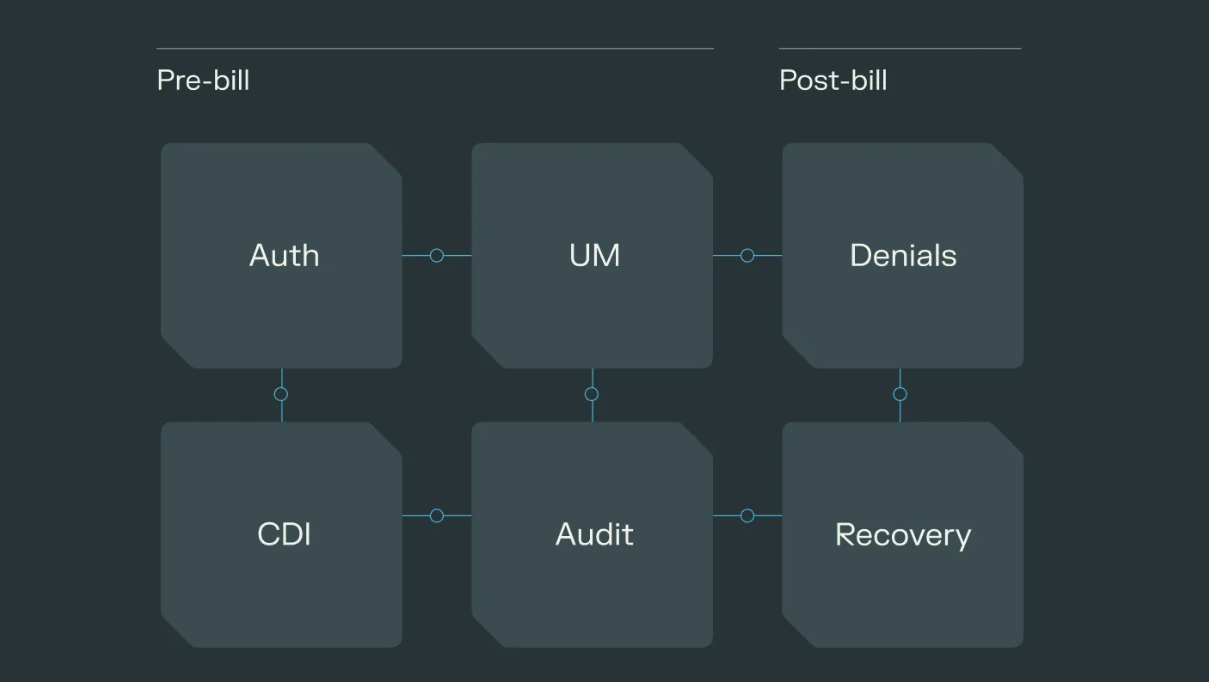
Reasonably than forcing well being programs into monolithic rip-and-replace implementations, Phare OS provides a modular path supported by outcome-based pricing, permitting hospitals to deploy focused automation the place monetary leakage is most acute and develop throughout the income cycle over time. 4 modules are commercially accessible instantly—Phare Auth, Phare Audit, Phare UM, and Phare Denials—whereas Phare CDI and Phare Restoration are presently working in early entry forward of broad industrial availability in 2027.
All six workflow engines draw upon a single underlying intelligence basis. A unified Knowledge Platform reconciles medical and monetary information, feeding Phare Intelligence, a medical reasoning engine that evaluates documentation towards payer medical necessity standards. Powering these determinations is Payer Atlas, an intelligence layer knowledgeable by greater than 1.25 billion annual payer transactions and real-time monitoring of over 115,000 industrial and authorities payer insurance policies.
Inside this linked atmosphere, every module executes specialised duties whereas feeding knowledge again into the core system. Following the closing of R1’s acquisition of Humata Well being, Phare Auth automates prior authorizations on the level of order entry, whereas Phare UM manages concurrent utilization opinions and Phare CDI ensures medical documentation integrity earlier than discharge. Instantly previous to billing, Phare Audit scrubs claims for coding accuracy. On the again finish, the newly launched Phare Denials automates technical and medical enchantment creation by pulling the unique authorization and medical necessity logic instantly into the enchantment packet, whereas Phare Restoration identifies post-payment underpayments. Crucially, payer adjudication outcomes captured by Phare Denials feed instantly upstream into pre-bill modules, stopping recurring denial patterns earlier than future claims go away the clearinghouse.
“We’ve established Phare OS as the muse for a distinct mannequin of income administration the place know-how isn’t measured by what number of duties it automates, however by the outcomes it delivers,” stated Joe Flanagan, Chief Government Officer of R1. “After a long time of serving to suppliers navigate the complexity of income cycle, we all know what it takes to enhance efficiency. We’re bringing that experience along with AI and payer intelligence, and we stand behind the outcomes. That is the extent of accountability well being programs ought to anticipate from their income administration companions.”